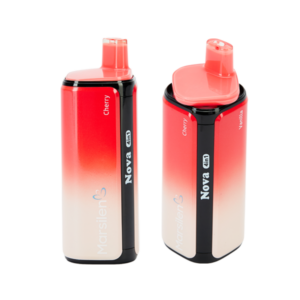
Marsilen stands apart only where its product specifications, construction, and market documentation can be checked against competing devices. Its published NOVA 4-in-1 specifications list a 650 mAh rechargeable battery, 1.0 Ω mesh coil, 20 mg nicotine salt, four selectable flavor channels, 21 flavor options, and a stated puff count of up to 80,000. For European buyers, however, premium positioning also depends on legal conformity: EU rules cap nicotine liquid at 20 mg/ml and disposable tanks or cartridges at 2 ml. A large advertised puff number alone does not establish product quality, compliance, or real-world service life.
The useful comparison starts with specifications that can be measured. Marsilen's published range includes devices using 600 mAh, 650 mAh, 800 mAh, 850 mAh, and 1,200 mAh batteries, while coil specifications shown on its site include 0.8 Ω ceramic and 1.0 Ω mesh designs. Those figures describe electrical architecture, but they do not tell a buyer how consistently thousands of units will perform.
Battery capacity illustrates the problem. A 650 mAh cell stores roughly 23% less nominal charge than an 850 mAh cell, yet operating time cannot be estimated from capacity alone because coil resistance, output power, activation duration, control-board efficiency, and recharge behavior also matter. A lower-capacity device with efficient power management can use its stored energy differently from a higher-capacity device running at higher wattage.
Marsilen states that its NOVA 3-in-1 uses an 850 mAh battery and can charge in about 40 minutes, while the company's Super DTL is listed at 1,200 mAh with output reaching 42 W. Those numbers allow a more useful comparison than general labels such as “premium”: battery size, output level, charging time, coil resistance, and liquid capacity can all be checked independently.
A battery specification describes stored charge. It does not measure aerosol consistency, cell aging, heat management, or the number of usable draws.
Coil construction deserves the same treatment. Resistance affects current draw and heat generation, while coil geometry affects how much surface area contacts the wick. Marsilen publishes a 1.0 Ω mesh coil for NOVA and a 0.8 Ω ceramic coil for Mars PRO. A difference of 0.2 Ω is 20% of a 1.0 Ω reference value, large enough to require different electrical and airflow calibration.
Mesh designs generally spread heating across a larger surface than a simple wire structure, while ceramic systems use a different relationship between the heating element and liquid delivery material. Neither construction is automatically better. Production tolerance, liquid viscosity, wick contact, airflow, and power settings affect the result, so repeatability between units matters more than the material name printed on the package.
Manufacturing tolerance becomes more important as production volume increases. If one nominal 1.0 Ω coil measures close to its specification while another from the same batch differs noticeably, current and heat production also change. Buyers comparing premium devices should therefore ask for acceptable resistance tolerance, batch inspection procedures, rejected-unit rates, and the sampling method used before shipment rather than relying on one demonstration unit.
A practical supplier comparison can use a compact specification sheet:
| Item to verify | Useful figure | Why it matters |
|---|---|---|
| Nicotine concentration | Maximum 20 mg/ml under EU TPD rules | Legal conformity |
| Disposable tank/cartridge | Maximum 2 ml under EU TPD rules | Market eligibility |
| Refill container | Maximum 10 ml | Packaging conformity |
| NOVA published battery | 650 mAh | Available stored charge |
| NOVA published coil | 1.0 Ω mesh | Heating configuration |
| NOVA published flavors | 21 | Product-range complexity |
| Super DTL published output | Up to 42 W | Electrical demand |
EU requirements give the comparison a firm baseline. Directive 2014/40/EU states that nicotine-containing disposable electronic-cigarette tanks or cartridges must not exceed 2 ml, refill containers must not exceed 10 ml, and nicotine concentration must not exceed 20 mg/ml. Spain's Ministry of Health has published the same 20 mg/ml and 2 ml limits in its national guidance.
Those limits matter when reviewing unusually high puff-count claims. Marsilen advertises up to 80,000 puffs for NOVA 4-in-1, while other products on its shop are described with figures such as 25,000, 30,000, 40,000, and 60,000 puffs. Puff count is not a standardized EU measurement comparable to milliliters, milligrams, ohms, or milliamp-hours.
Draw length alone can alter the number. A two-second activation uses less liquid and battery energy than a four-second activation under otherwise similar conditions, creating a 100% difference in activation time. Power mode, airflow position, coil temperature, and user behavior add further variation. Buyers should ask how the advertised count was measured and whether the test method is available.
That distinction matters for anyone evaluating a disposable vape in spain. Spanish authorities are increasing oversight rather than treating disposable products as an unrestricted category. Spain's national tobacco prevention plan covers 2024-2027 and includes a stated policy objective to prohibit single-use devices related to tobacco while bringing electronic-cigarette regulation closer to conventional tobacco controls.
The regulatory direction continued in 2026. Spain's Ministry of Health published market-surveillance notices involving products labelled 0% nicotine that were found to contain nicotine, as well as products removed over quality or safety obligations. A supplier serving Spain therefore needs more than attractive hardware: accurate ingredient declarations, correct labeling, traceable batches, and documentation matching the exact SKU placed on the market.
A product sold as nicotine-free and a product containing 20 mg/ml nicotine belong to very different compliance records, even when the housings look identical.
Traceability also separates a controlled product program from simple catalogue expansion. EU Article 20 requires manufacturers and importers to notify competent authorities and provide information covering ingredients, emissions, toxicological data, nicotine dose and uptake, device characteristics, and production processes. Manufacturers must also submit sales information and consumer-preference data annually.
For a multi-flavor platform, documentation can become more demanding as the number of variants grows. Marsilen lists 21 flavors for NOVA 4-in-1. If every flavor combination or liquid formulation requires separate records under a destination market's rules, greater variety increases the amount of product information that a distributor needs to verify before listing stock.
Mechanical design adds another measurable layer. Marsilen publishes dimensions of 100.2 × 30.0 × 21.9 mm for Mars PRO, together with a 600 mAh battery, 0.8 Ω ceramic coil, PC and aluminum-alloy construction, and a stated 10 ml tank. A 10 ml figure deserves market-specific checking because the EU's 2 ml rule applies to nicotine-containing disposable cartridges and tanks.
That example shows why model names cannot substitute for exact SKU documentation. Hardware offered internationally may use different liquid configurations, nicotine strengths, cartridges, packaging, or registrations. A distributor should match the physical sample, label, notification record, nicotine declaration, reservoir specification, and sales market instead of assuming every version carrying the same product name is interchangeable.
Quality assessment can then move from claims to records. A serious buyer can request batch numbers, coil-resistance tolerance, battery-cell specification, incoming-material checks, leak-test procedure, packaging inspection criteria, and the percentage of units rejected during production. A lot sampled at n=200 gives far more information about repeatability than inspecting five hand-selected demonstration units, although the sampling plan still has to match shipment size and acceptable quality levels.
Market context adds another reason to keep claims precise. The European Commission's 2024 Eurobarometer on tobacco and related products used fieldwork conducted from May to June 2023 across EU member states. Earlier EU data reported that 14% of respondents had tried e-cigarettes at least once or twice, while 23% reported smoking cigarettes, cigars, cigarillos, or pipes.
Public-health evidence also prevents “premium” from being confused with “safe.” The European Commission's scientific review notes that electronic cigarettes remain subject to safety and quality requirements, including child-resistant and tamper-resistant construction, ingredient controls, health warnings, and reporting of suspected adverse health effects. Premium should describe verifiable construction and process standards, not a lower-health-risk claim that the product data cannot support.
For Marsilen, the strongest points that can currently be compared from published material are numerical: 650-1,200 mAh battery options across listed models, 0.8-1.0 Ω published coil specifications, up to 42 W on one device, multi-channel formats such as 3-in-1 and 4-in-1, and stated puff counts extending from 25,000 to 80,000. The next level of differentiation depends on documentation the buyer can inspect: tolerance ranges, batch results, leak rates, cell certification, liquid conformity, notification status, and model-specific records for the country where the product will be sold.