Community Signals Beyond the Ranking Page
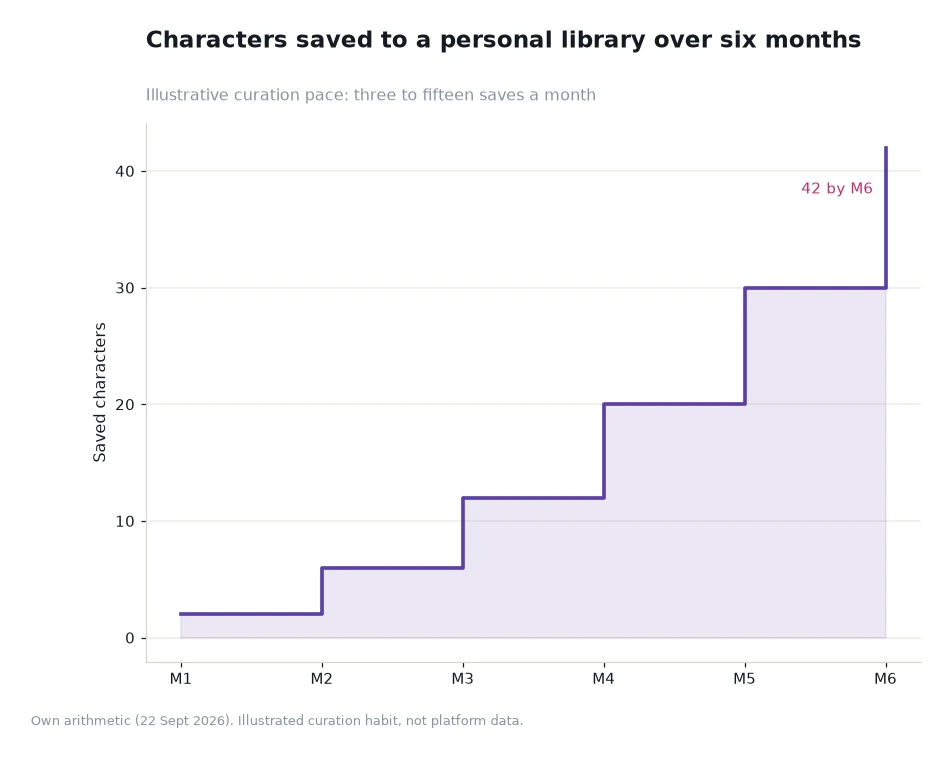
The chart is not the only place a character gets talked about, and treating it as the whole picture is how readers end up following hype instead of interest. Crushon links its official social channels from the site itself — YouTube, TikTok, Reddit, Discord and X — and the creators behind the cards carry followings of their own off the page. A six-month save curve rising from 2 to 42 characters is a reminder that the useful signal is what you keep choosing, not what a feed discussed this week.

Key takeaways
- Community signals are faster than the chart but less controlled: a mention can move attention in hours, while the page refreshes weekly.
- Creator followings travel: a maker with an audience off the platform can lift a new card onto the 20-slot list quickly.
- Save rate is the on-page check on off-page buzz — 7.1K favourites on 24.3M views is 0.029%, a rate no amount of chatter can substitute for.
- If a third of six months' saves came from a community recommendation, that is about 14 of 42 characters, and the rest came from your own browsing.
What counts as a community signal
The clearest signals are the ones the platform itself maintains: official accounts on the major networks, a Discord server and a subreddit where readers compare notes. These channels move far faster than a weekly refresh. A card can be discussed for days before it registers on the chart, and by the time it appears, the discussion has often already moved on.
Creator followings are the second signal. Because cards carry a credit line, a maker's existing audience is a ready-made distribution channel: a new character from a followed creator will be opened by people who never visited the trends page that week. The third signal is the loosest — mentions in unrelated places, clips, screenshots and casual references. Those are the hardest to verify and the easiest to over-weight, because a mention tells you that someone was interested, not that the character is any good.
None of these signals is useless. They tell you where to look next, which is a genuinely helpful function when a library is large. The mistake is treating them as conclusions. A recommendation is a hypothesis about whether you will enjoy something, and the only test that settles it is one session of your own.
Weighing off-page noise against on-page numbers
The ranking page gives you a check that off-page chatter cannot provide: counters, read at a fixed moment, that you can convert into a rate. If a character is being discussed widely and its card shows a save rate near the top of the page, the discussion is consistent with the data. If the discussion is loud and the save rate is at the bottom of the range, the interest is probably curiosity rather than commitment.
Timing explains most disagreements between the two. A community wave takes a few days to show up in counters, so a card that looks quiet on Thursday may look different the following week. That lag is a reason to keep a note of what you were told about rather than a reason to dismiss the counters, which are the only numbers anyone outside the platform can read for themselves.
| Signal | Typical lag | Weight to give it | On-page check |
|---|---|---|---|
| Official channel post | Hours | High — it comes from the platform itself | Confirm the feature or card still exists on the site |
| Creator announcement | Hours to days | High if you already follow the maker | Look for the new card's counters after the first week |
| Community discussion | Days | Moderate — opinion, not measurement | Compare the save rate with the top of the page |
| Casual mention or clip | Unknown | Low until verified | Find the card and read both counters before deciding |
| Your own saved list | Slow but reliable | Highest — it records your own decisions | Review which saves you actually reopened |
Worked example: how much of a library comes from recommendations
The chart beside this section plots cumulative saves, so the monthly additions are what matter. Month one: 2. Month two: 6, adding 4. Month three: 12, adding 6. Month four: 20, adding 8. Month five: 30, adding 10. Month six: 42, adding 12. The increments sum to 2 + 4 + 6 + 8 + 10 + 12 = 42, or 7 a month on average. These are illustrative figures rather than platform data.
Now attribute the sources, illustratively. If one save in three arrived because of a community recommendation — a Discord discussion, a creator post, or a clip — then 42 × 0.33 ≈ 14 characters came from signals beyond the page, and about 28 came from your own browsing and searching. Run the same split at the top of the chart and the numbers are larger but the shape is the same: a card at 24.3M views and 7.1K favourites is converting arrivals into saves at 0.029%, and no recommendation changes that rate for you personally.
The ratio worth tracking is the one between what you were told about and what you kept. Fourteen characters from outside signals is a healthy pipeline; forty-two would suggest the list is being built by other people.
Turning signals into a shortlist
The workable routine is to collect leads in one place and verify them in another. Leads arrive from official channels and from the weekly nsfw ai chart, which ranks 20 NSFW AI characters each week and links the platform's own social accounts from the same site. Verification happens by reading the counters and tags on a card: the character search page is the fastest way to check whether a name you heard fits a category you already use, and the weekly rankings view shows whether a recommended card is holding attention across refreshes.
Two habits keep the pipeline honest. Write down where a recommendation came from, so that a year later you can see whose tips you actually kept; and never let a recommendation become a save without one session of your own. A lead is cheap; a filled list of things you barely opened is not.
Frequently asked questions
Are community recommendations reliable?
They are useful leads and unreliable verdicts. Discussion tells you what people are curious about, while the card's own counters show how many arrivals turned into saves. Weighing the two together is more accurate than trusting either alone.
Why do recommended characters sometimes look quiet on the chart?
Because the page refreshes weekly and discussion moves faster. A wave of community attention may take several days to appear in the counters, so a card can look quiet on Thursday and much busier the following week.
Which signal should carry the most weight?
Your own saved list. It is the only record that shows what you kept and reopened, and unlike a public channel it cannot be shaped by anyone else's enthusiasm.
Keep leads and commitments separate
Set up one note for leads from official channels and creator posts, and a second list for characters you actually opened. Review both monthly: promote anything worth keeping into the main list, and delete leads that have gone stale after a fortnight. That two-list habit is enough to benefit from community signals without letting them decide what your library contains.
Data and sources: the trends page counters and the official channels linked from the platform[1], read 22 Sept 2026. Save attribution and conversion figures are illustrative assumptions, not platform data. Written for readers aged 18+.