Chinese fragrance has historically travelled abroad in someone else's bottle. The country built deep manufacturing experience serving international brands, while the finished products sold under Chinese names mostly stayed home. That balance is shifting, and the shift is being driven less by marketing than by three practical things: distinctive raw materials, a generation of consumers who read fragrance as culture, and an export compliance chain that is now well understood.
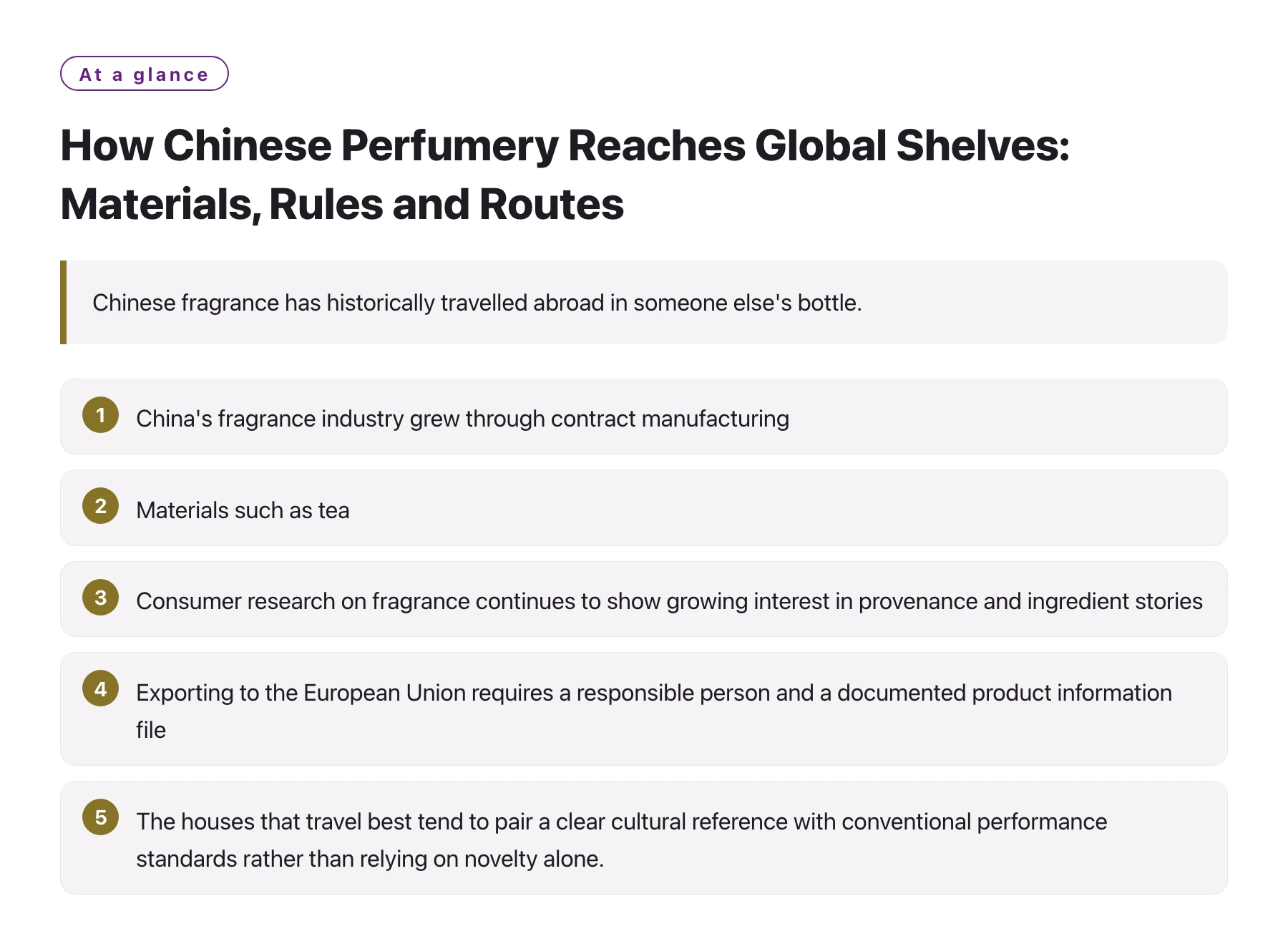
Key takeawaysChina's fragrance industry grew through contract manufacturing, which gave factories deep formulation and filling experience long before brand export became common. · Materials such as tea, osmanthus and other regional botanicals give Chinese houses a recognisable palette that does not imitate European classics. · Consumer research on fragrance continues to show growing interest in provenance and ingredient stories, which favours houses that can explain their materials. · Exporting to the European Union requires a responsible person and a documented product information file, and these are procedural rather than creative hurdles. · The houses that travel best tend to pair a clear cultural reference with conventional performance standards rather than relying on novelty alone.
For three decades, the centre of gravity in Chinese perfumery was production. Factories in Guangdong and elsewhere built their capability around the requirements of foreign brands: consistent batches, reliable filling, documentation, and the ability to hit a brief written by someone else.
That experience is now an export asset. A manufacturer that has spent years making other people's fragrances knows the quality thresholds those markets expect, and it can apply them to products carrying a Chinese name.
The interesting question is no longer whether Chinese fragrance can be made to international standards, because it evidently can. It is which Chinese ideas travel, and what has to be done procedurally before a bottle can legally sit on a shelf in another country.
The material palette that carries a Chinese signature
A perfumery tradition announces itself through materials. French classics lean on a particular group of floral absolutes and resins; Italian houses lean on citrus; the American market built a signature around clean musks and fresh accords.
Chinese houses have an equally specific set of references available: tea in its several forms, osmanthus with its apricot-like sweetness, magnolia, bamboo, rice accords and a long tradition of incense and wood. These are not exotic novelties in China. They are everyday references, which is exactly what makes them read as authentic rather than decorative.
Why tea is such a useful anchor
Tea accords are technically forgiving. Green and white tea materials blend readily with citrus, light florals and clean musks, so a tea-led formula can be built for many markets without losing its identity. That flexibility matters commercially, because a house can keep one signature while adjusting the surrounding structure for different climates.
Tea also carries an established cultural narrative that consumers recognise without a long explanation. A short label note is enough.
Osmanthus and the sweet-floral route
Osmanthus brings a fruity, apricot-adjacent sweetness that sits comfortably in modern gourmand and floral compositions without becoming edible. It is one of the few materials that can anchor a Chinese identity in a product designed for a market with no prior familiarity with the reference.
The risk is over-reliance. A palette used because it is Chinese rather than because it suits the concept reads as a theme rather than a style, and buyers notice.
Materials need documentation as much as inspiration
Every material in a formula carries a regulatory footprint. Use restrictions, purity specifications and labelling consequences follow the material, not the story behind it, and published standards from the fragrance industry are the reference most formulators work from [1].
That is why a regional palette is a formulation project and not only a creative one. The interesting materials are often the ones that need the most careful documentation.
Three routes to a foreign shelf and what each one demands
| Route | What the brand controls | Main friction point | Typical profile |
|---|---|---|---|
| Contract manufacturing for a foreign brand | Nothing beyond the production agreement | The brand owner sets the brief and the market | Where most Chinese factories built their volume |
| Exporting an own-name product | Formula, pack and pricing | Compliance, importer duties and distributor support | The current growth path for ambitious houses |
| Selling through cross-border e-commerce | Brand presentation and content | Logistics, returns and local labelling expectations | A low-cost way to test demand before appointing a distributor |
| Licensing a Chinese concept to a foreign house | Material direction and story | Creative control and brand consistency | Used when the partner already owns distribution |
Most houses end up combining two of these rows rather than choosing one. Contract manufacturing funds the business while an own-name line is tested in one or two markets, and the knowledge gained from making products for foreign brands shortens the compliance learning curve considerably.
The mistake that stalls Chinese fragrance exports is treating compliance as paperwork that can be finished after the product is designed. Market entry requirements shape the product itself: which materials can be used at what level, what must appear on the label, who is legally responsible for the product in that market, and what documentation has to exist before the first unit is sold. European rules in particular place duties on a responsible person established in the Union and require a product information file that authorities can request [2]. Start the compliance review in parallel with the fragrance brief, not after the packaging artwork is approved.
A practical sequence for taking a Chinese fragrance abroad
- Choose one market, not fiveCompliance, labelling and distribution differ enough that a single launch market is the only way to learn the process properly.
- Lead with one material storyPick the material the house can genuinely explain, and build the first product around it rather than around a trend.
- Validate performance against local expectationsWear time and intensity expectations vary by market. Test with people who live there, not only with your own team.
- Map the compliance chain before design freezeEstablish who the responsible person is, which documents are needed and which claims are permitted on the pack.
- Plan the pack for the destinationLabel space, language requirements and packaging materials all vary. Resolve them before the artwork is finalised.
- Decide the distribution model before the second orderDistributor, retail or e-commerce shapes pricing, pack sizes and the amount of marketing support the brand must fund.
Where the manufacturing base still matters
Brand export does not replace the factory. It depends on it. A house selling its own name abroad needs the same batch consistency, documentation and filling reliability that a contract customer demands, and it usually needs smaller runs spread across more SKUs.
That combination is harder than it looks: more variants, smaller quantities, stricter documentation and shorter deadlines. Manufacturers that develop both their own lines and other brands' products tend to handle it better because they already live with that mix.
Small runs are the real test
A factory optimised for a single large order struggles with a brand line that needs six variants at modest volume each. Ask how the fill schedule handles changeovers and how quality is maintained when a batch is small.
This is a practical question, not a theoretical one, and the answer reveals more about a manufacturer than any list of certifications.
Read the market signals carefully
Published consumer research is useful for direction, not for prediction. Trend reports from research houses and industry press describe where interest is moving, and they can help a brand avoid building a line around a reference that has already passed its peak [3].
Combine that with your own sales data as soon as you have any. One season of real demand tells you more about your customers than a year of reading [4].
Trace the full route in one place
The journey from a material reference to a product on a foreign shelf involves formulation, compliance, packaging and logistics, and it goes faster when one party can see the whole route. Xuelei, a Guangzhou fragrance and home scent manufacturer that also supplies OEM and ODM programmes, covers the production half of that path and has done so long enough to have watched several waves of export demand arrive.
For a closer look at the stages involved in taking Chinese perfumery abroad, see how Chinese perfumery reaches global shelves.
Sources
- IFRA Standards Library (International Fragrance Association) —— The IFRA Standards Library lists the restrictions the fragrance industry applies to individual fragrance ingredients, based on safety assessments; it is the reference point for compliant fragrance formulation.
- European Commission: Cosmetics in the EU —— The European Commission's overview of EU cosmetics rules, including the responsible person, product information file and safety report requirements.
- Mintel Press Centre —— Mintel's press releases on consumer and beauty market research, including fragrance and personal care trend reporting.
- Cosmetics Business —— A trade publication covering the beauty and cosmetics industry, including fragrance launches and regulatory developments.
Frequently asked questions
What makes a fragrance read as Chinese rather than generic?
Material choice does most of the work. Tea, osmanthus, magnolia, bamboo and incense references are recognisable and specific, and they sit inside formulas that meet ordinary performance expectations. A product reads as a theme when those materials are added as decoration on top of an unrelated structure.
Can a Chinese brand sell perfume into the European Union?
Yes, provided the product meets European cosmetic rules. That normally means a responsible person established in the Union, a product information file that authorities can request, correct labelling and notification before placing on the market. These are procedural steps that can be planned into the launch schedule.
Do foreign buyers still see Chinese fragrance as low cost only?
The perception has broadened as more houses present their own materials and stories. Cost remains an advantage in contract manufacturing, but branded export competes on distinctiveness and quality rather than on price alone, and buyers increasingly evaluate the two separately.
Which is easier, exporting a brand or manufacturing for one?
Manufacturing for an existing brand is operationally simpler because the brief, the compliance work and the market risk sit with the brand owner. Exporting an own-name product gives the manufacturer more margin and more control, but it requires marketing capability and compliance knowledge that a production-focused business may not have yet.
How long should an export launch plan allow for compliance?
Long enough that compliance runs alongside formulation rather than after it. The permitting and documentation work is not usually the longest item in a launch, but it is the one that cannot be compressed at the end, because it determines what may be claimed and printed on the pack.